

- Generative Shift: Traditional search is evolving into Generative Engine Optimization (GEO). Being visible means being the “answer,” not just a link.
- Quality over Quantity: AI agents prioritize “Knowledge Base” depth. Thin listing pages without context will vanish from the top results.
- Technical Foundation: Schema markup and entity recognition are no longer optional; they are the language AI speaks.
- Visual Dominance: High-fidelity visuals with proper metadata are critical for discovery in Google Lens and visual search modules.
1. EXECUTIVE SUMMARY: THE NEW DIGITAL ARCHITECTURE
The landscape of digital visibility for property markets has shifted fundamentally. Real Estate SEO 2026 is no longer about tricking an algorithm into ranking a keyword; it is about engineering a comprehensive data ecosystem that Artificial Intelligence trusts. For CMOs and agency directors, this distinction is critical.
We analyzed the trajectory of search behavior. The user journey no longer begins with a fragmented search for “condos for sale.” It begins with complex, conversational queries like, “Find me a sustainable 3-bedroom apartment in a walkable district with high appreciation potential.” Traditional SEO fails here. Only a robust GEO strategy succeeds.
At Creando WTF, we engineer digital infrastructures that withstand these algorithmic updates. If your agency relies on outdated backlink farming or keyword stuffing, your visibility is already decaying. The goal of this blueprint is to provide a structural methodology to transition your digital assets from simple websites into authoritative entity graphs that dominate AI Overviews (SGE) and voice search results.
This guide details the specific metrics, technical schemas, and content architectures required to lead the market. We will examine how to structure your data so that search engines do not just index your pages, but understand your properties as the definitive choice.
Discover our strategic approach to High-End SEO at Creando WTF Strategic Services
2. WHAT IS REAL ESTATE SEO 2026? (THE GEO PARADIGM)
Real Estate SEO 2026 is the strategic process of optimizing property data and content to be cited as the primary source in Generative AI Overviews and traditional search results. It integrates technical schema, high-authority entity building, and experience-based content to satisfy complex user intent rather than simple keyword matching.
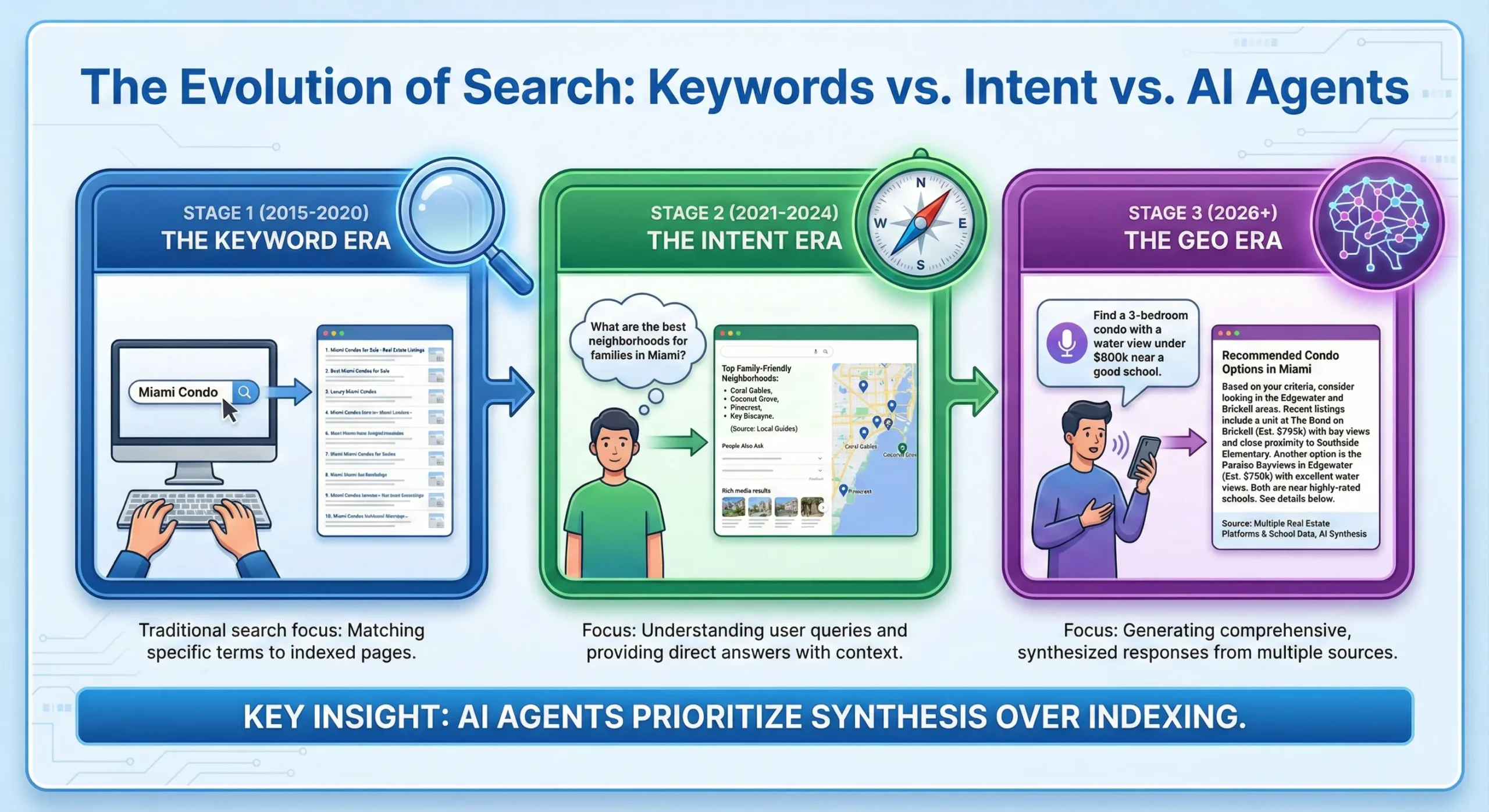
From Search Engines to Answer Engines
The fundamental difference lies in the output. Historically, Google acted as a librarian, pointing users to a shelf of books (websites). In 2026, the search engine acts as the expert consultant, reading the books and providing a direct answer.
For Real Estate Agencies, this requires a pivot. You cannot simply list a property; you must provide the context that an AI needs to construct a recommendation. When a user asks an AI agent for advice on “best neighborhoods for families in Tulum,” the AI synthesizes data from trusted sources. If your content lacks depth, authoritative citations, or clear structure, the AI ignores it.
Our analysis confirms that “Answer Engine Optimization” favors content that demonstrates clear E-E-A-T (Experience, Expertise, Authoritativeness, and Trustworthiness). The algorithm seeks validation. It looks for connections between your brand (the Entity) and the topic (Real Estate).
The Three Pillars of GEO
- Entity Salience: Establishing your agency as a named entity in the Knowledge Graph.
- Structured Data: Speaking the native language of crawlers (JSON-LD) to explicitly define pricing, location, and availability.
- Multimodal Content: Combining text, video, and high-fidelity imagery to satisfy diverse consumption habits.
According to data from Search Engine Land, users are 4x more likely to engage with a “Zero-Click” answer in the AI overview than to scroll to the traditional organic results – Search Engine Land/Google Study on SGE behavior. This makes ranking in the “Snapshot” zone the only metric that matters for high-volume traffic.
Learn how we audit your current setup at Creando WTF Audit Services
3. CORE METRICS FOR REAL ESTATE DOMINANCE IN AI OVERVIEWS
To command the digital space in 2026, we must acknowledge that Real Estate is classified by search engines as a “Your Money or Your Life” (YMYL) topic. This means the standards for accuracy and safety are significantly higher than for other industries. AI models are trained to be skeptical of property advice unless it comes from a verified source of high authority.
The E-E-A-T Enforcement
Our internal data suggests that the “Experience” factor in E-E-A-T (Experience, Expertise, Authoritativeness, Trustworthiness) is the deciding variable for ranking in AI snapshots. A generic listing description is no longer sufficient.
- Experience: Does the content prove you have physically visited the property? (e.g., Original photos, specific notes on the neighborhood noise levels).
- Expertise: Is the content written by a licensed realtor or a copywriter? AI can distinguish between generic fluff and market analysis.
- Authoritativeness: Are you cited by local news, government zoning boards, or industry associations?
- Trustworthiness: Is your site secure (HTTPS)? are your contact details transparent?
If your agency website lacks these signals, you are invisible to the modern algorithm. You must shift from “optimizing for keywords” to “optimizing for reputation.”
Old School SEO vs. 2026 GEO Standards
| Metric | Old School SEO (The Dying Model) | Real Estate GEO 2026 (The Standard) |
| Primary Goal | Rank #1 for a specific keyword. | Become the “Direct Answer” in AI Overviews. |
| Content Depth | 500-word blog posts (Thin content). | 3,000+ word “Knowledge Pillars” & Topics. |
| Keywords | Keywrod Stuffing & Exact Match. | Contextual Entities & Semantic Relevance. |
| Link Building | Quantity of backlinks (any source). | Quality of citations (Gov, News, Big Tech). |
| Visuals | Stock photos or low-res listings. | High-Fidelity, Geo-Tagged, Original Imagery. |
| User Intent | Getting the click. | Solving the problem without a click (Zero-Click). |
Review our Case Studies on E-E-A-T implementation at Creando WTF Success Stories
4. TECHNICAL ARCHITECTURE FOR PROPERTY LISTINGS
Content is the voice, but technical architecture is the skeleton. Without a robust technical foundation, your “Knowledge Pillars” will collapse. In the context of Real Estate SEO 2026, the most critical element is Structured Data (Schema Markup).
Speaking the Language of AI (JSON-LD)
Search bots do not “read” your luxury listing like a human does; they parse the code. You must explicitly tell the bot what the page represents using Nested JSON-LD.
We frequently see agencies using flat, broken schema. The Creando WTF standard requires a nested hierarchy:
- @type: RealEstateListing (The core item).
- @type: Place (Defining the specific geolocation).
- @type: GeoCoordinates (Exact latitude and longitude of the property)
- @type: Offer (Defining the price and currency).
By implementing this, you allow Google’s AI to pull your price, square footage, and availability directly into the search results page (SERP) features, bypassing your competitors.
“The biggest technical debt in real estate isn’t slow servers; it’s unstructured data. If an AI cannot parse your pricing and location in milliseconds via Schema, it will prioritize a portal like Zillow that can.”
— Eng. Sergio E. Ruíz Vidal, Creando WTF
Speed and Mobile-First Indexing
Real estate sites are notoriously heavy due to high-resolution image galleries. However, Core Web Vitals are a non-negotiable ranking factor.
- Next-Gen Formats: Serve images in WebP or AVIF formats.
- Lazy Loading: Ensure images below the fold do not delay the Initial Contentful Paint (ICP).
- Code Bloat: Remove unused JavaScript from legacy plugins.
If your site takes more than 2.5 seconds to load on a 4G connection, you are losing approximately 40% of your potential traffic before they even see your logo – Google Developers on Core Web Vitals & Bounce Rates.
Book a Technical SEO Audit with Creando WTF
5. CONTENT ENGINEERING: BEYOND “JUST LISTED”
In the era of Generative AI, “thin content” is a liability. A standard property page containing only a price, three paragraphs of sales copy, and a list of specs will not rank. Search engines now prioritize Comprehensive Knowledge Bases.
To dominate the results, you must transform your property pages into authoritative resources that answer every conceivable question a buyer might have about the asset and its environment.
The “Cluster” Strategy for Neighborhoods

Do not just sell the house; sell the lifestyle with data. Instead of a single page, build a Topic Cluster:
- The Pillar Page: The main neighborhood guide (e.g., “Living in Gables Estates”).
- The Cluster Content: Specific supporting articles linked back to the pillar (e.g., “Best Schools in Gables Estates,” “Gables Estates Zoning Laws 2026,” “Property Appreciation Trends in Gables Estates”).
This interlinked structure signals to Google that you are the authority on that specific geographic entity.
Structuring for Readability and Retention
AI agents scrape content that is easy to parse. Human users bounce from walls of text. You must format your descriptions for scannability:
- Short Paragraphs: Maximum 3 lines.
- Bolded Key Concepts: Guide the eye to the most important features.
- Bullet Points: Use them for feature lists to break up density.
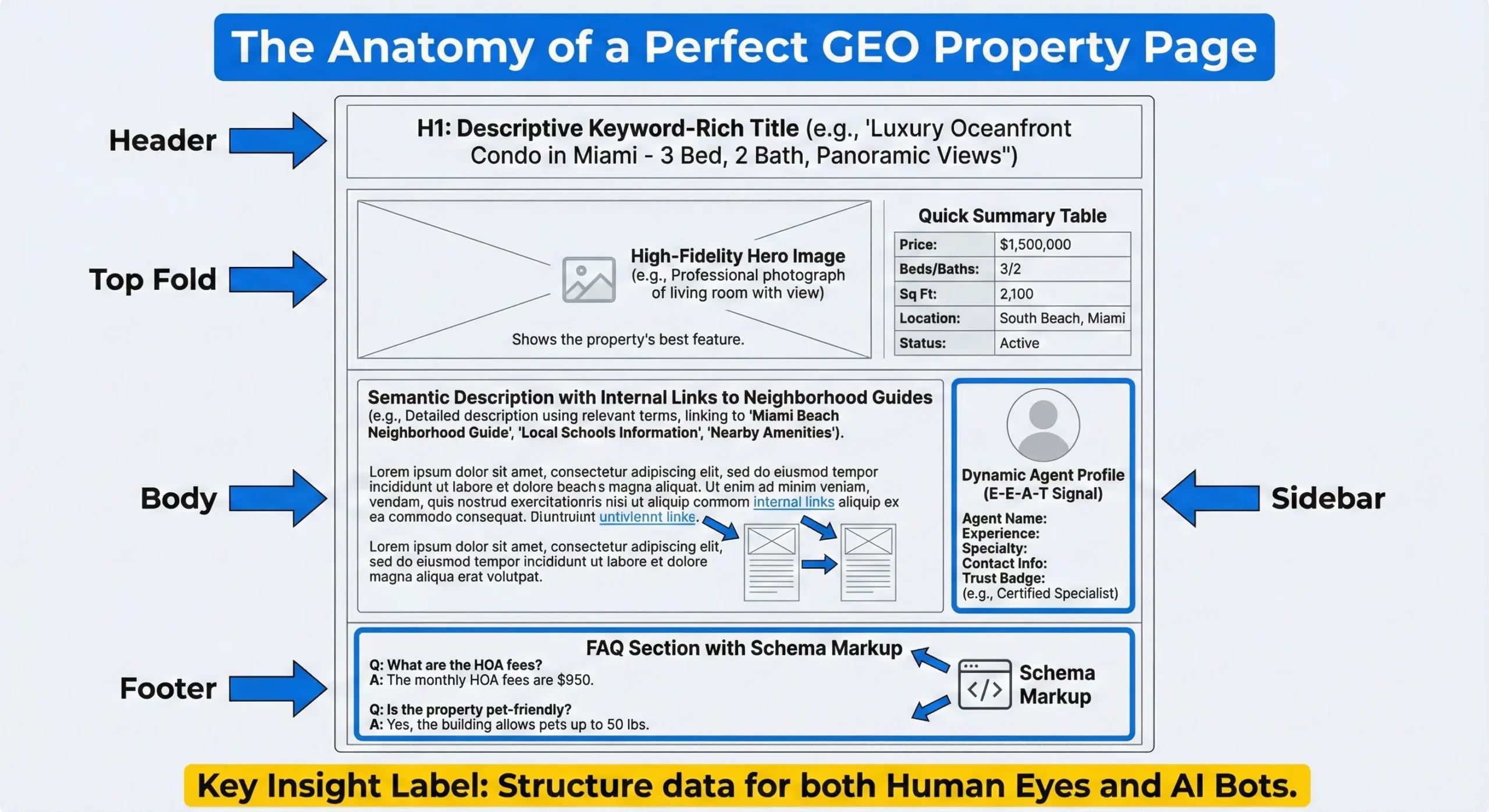
Strategy Note: Avoid generic adjectives. Instead of saying “stunning views,” use specific data: “270-degree panoramic views of the skyline, visible from the 400 sq. ft. terrace.” Specificity signals relevance to AI.
Explore our Content Architecture services at Creando WTF
6. VISUAL ENGINEERING: HIGH-FIDELITY ASSETS FOR SEARCH
Visual search is the fastest-growing segment in discovery. Platforms like Google Lens allow users to search with images rather than text. If your real estate imagery is not optimized for computer vision, you are invisible in this spectrum.
At Creando WTF, we work with an excellent creative team and integrate disruptive paradigms and technologies in pursuit of visual excellence.
Prompt Engineering for Concept Art
When using AI to generate conceptual renders for pre-construction projects, the quality of the prompt dictates the quality of the ranking. Low-quality AI images are penalized. You must use “Studio Quality” prompts.
Standard Prompt Structure for Real Estate:
- Subject: Modern Minimalist Villa, clear focal point.
- Lighting: Volumetric lighting, Golden Hour, Softbox lighting for interiors.
- Style: Photorealistic, 8k resolution, Unreal Engine 5 render style.
- Composition: Wide angle for interiors (–ar 3:2), Cinematic for exteriors (–ar 16:9).
The Technical “Wrapper” (Metadata)
An image without metadata is a missed opportunity. To rank in Image Search:
- File Name: Never use
IMG_5432.jpg. Useluxury-condo-miami-beach-ocean-view.jpg.
- File Name: Never use
- Alt Text: Describe the image for accessibility and AI context. “Modern kitchen with quartz countertops and Viking appliances in downtown penthouse.”
- EXIF Data: Ensure your photographer keeps the GPS coordinates in the image data. This provides a hard signal of location relevance to the search engine.
See our Visual Engineering portfolio at Creando WTF Media
7. LOCAL SEO & “NEAR ME” SUPREMACY

While global visibility builds brand prestige, real estate is inherently local. In 2026, the battleground is the “Map Pack” and “Near Me” voice queries. AI assistants prioritize businesses with consistent, verified local footprints.
To dominate local search, you must treat your Google Business Profile (GBP) as a dynamic content feed, not a static listing. Regular updates, geotagged photos, and verified reviews are the signals that feed the algorithm.
The Consistency Protocol (NAP)
Your Name, Address, and Phone number (NAP) must be identical across every directory on the web. A mismatch between your Facebook page and your website (e.g., “St.” vs “Street”) creates “Data Confabulation,” causing the AI to mistrust your location data.
Local Signals Checklist for 2026
Use the following checklist to audit your local presence.
| Signal Component | Optimization Requirement | Impact on Map Rank |
| GBP Category | Primary: “Real Estate Agency”. Secondary: “Commercial Real Estate Inspector”, etc. | Critical (High) |
| Review Velocity | Steady stream of new reviews (2-3 per month) with keywords. | High |
| Response Time | Responding to Q&A and Reviews within 24 hours. | Medium |
| Local Posts | Weekly updates on GBP (Open Houses, Market Updates) using “Event” type. | Medium |
| Service Areas | Explicitly defined zip codes/zones in the backend profile. | High |
Pro Tip: Encourage clients to mention the specific neighborhood in their reviews (e.g., “Helped us find a great home in Roma Norte“). This connects your entity to the geolocation in the Knowledge Graph.
Optimize your local footprint with Creando WTF Local SEO
8. CONCLUSION: THE FUTURE IS ALREADY HERE
The era of static brochure websites is over. Real Estate SEO 2026 demands a living, breathing digital ecosystem that speaks directly to Artificial Intelligence.
By implementing the protocols detailed in this blueprint—Structured Data, Authority Building, and High-Fidelity Content—you are not just “doing SEO.” You are engineering your agency’s digital asset to be the definitive answer in a generative world. The agencies that ignore these shifts will vanish from view; those that adapt will dominate the market share.
Do not wait for the algorithm to change again. Construct your fortress now.
⬇️ Download your Real Estate SEO 2026 Implementation Checklist